

Currently Empty: $0.00

Course Description
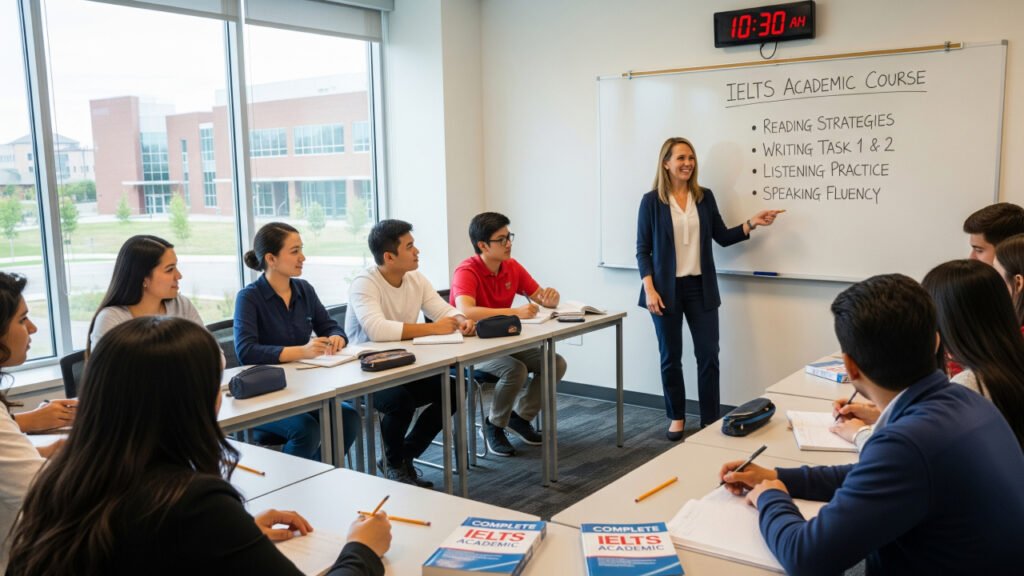
IELTS Academic is a globally recognized test of English designed for those who want to study at undergraduate or postgraduate levels or seek professional registration in English-speaking environments (for example, healthcare, engineering, academia). It measures whether you have the English language skills needed in an academic setting.
Who Should Take This Course?
- Students applying to universities where instruction is in English.
- Professionals needing credentials for licensing or registration in fields such as medicine, law, research.
- Those aiming for a high band score to satisfy visa or scholarship requirements.
- Anyone who wants to improve their academic reading, writing, speaking and listening in a rigorous, structured way.
Test Format & Timings
The course prepares you for all four sections of the IELTS Academic test:
| Component | Time / Structure |
| Listening | ~30 minutes (plus 10 minutes to transfer answers); 4 parts, 40 questions |
| Reading | 60 minutes; 3 long academic texts, 40 questions total |
| Writing | 60 minutes; Task 1 (describe visual data – graph/table/chart/diagram); Task 2 (essay, point of view / argument / problem solving) |
| Speaking | 11-14 minutes; face-to-face with examiner in 3 parts: interview/introduction; long speaking turn; question & discussion |
Total test time is about 2 hours 45 minutes (Listening, Reading, and Writing taken consecutively; Speaking may be on a different day).
What Skills Are Tested & What to Expect
Listening
- Four recordings including conversations and monologues.
- First two parts cover every day, social situations; last two parts focus on educational / academic contexts.
- Question types include multiple choice, matching, plan/map/diagram labelling, form and note completion, short answer, etc.
- You hear recordings only once. Being able to follow and understand different accents is important.
Reading
- Three passages; texts are drawn from books, journals, magazines, newspapers — all appropriate for academic studies.
- Expect a variety of styles: descriptive, narrative, discursive, argumentative. At least one passage will feature a logical argument. Charts, graphs or illustrations might be included.
- Questions test skimming, scanning, reading for gist, detail, inference, recognizing writers’ claims or opinions. Question types include True/False/Not Given, matching headings, sentence completion, summary completion, etc.
Writing
- Task 1: Describe or summarise a chart, table, diagram, graph etc. Write at least 150 words in about 20 minutes.
- Task 2: Essay of at least 250 words, requiring you to respond to a point of view, argument or a problem. You’ll need to organise ideas clearly, use examples/evidence, and maintain an academic or semi-formal style. About 40 minutes allotted.
- Scoring is based on criteria like Task achievement / Task response, Coherence and cohesion, Lexical resource, Grammatical range and accuracy.
Speaking
- Three parts:
- Introduction & Interview — familiar topics (your background, home, studies, interests).
- Long Turn — you are given a topic card, 1 minute to prepare, then speak for ~2 minutes, followed by some follow up questions.
- Discussion — more abstract questions related to the Part 2 topic; opportunity to express opinions, analyse, compare, speculate.
- Assessed on fluency & coherence; vocabulary (lexical resource); grammar; pronunciation.
Scoring & Band System
- Each section (Listening, Reading, Writing, Speaking) is scored on a band scale from 1 to 9 (whole or half bands).
- You also get an overall band score, computed as the average of the four component scores, rounded to the nearest half band.
How This Course Helps You Prepare
With this course, you will:
- Gain deep familiarity with the format of each section and the kinds of question types used.
- Learn techniques for efficient reading and listening (e.g. skimming, scanning, note-taking, identifying paraphrases).
- Practice writing in an academic style—structuring essays, summarizing visuals, using complex sentences and appropriate vocabulary.
- Develop speaking confidence: expressing ideas fluently, organizing arguments, improving pronunciation and coherence.
- Take timed mock tests to build stamina and get used to exam timing pressures.
Course Content
Introduction To Mobile App Development
You don't currently have access to this content
4 Topics
What is an Android App?
You don't currently have access to this content
What is Android Studio?
You don't currently have access to this content
Android Studio Installation Requirements
You don't currently have access to this content
Android Studio Setting the Environment
You don't currently have access to this content
Exploring Android Studio
You don't currently have access to this content
3 Topics
Android Project Structure
You don't currently have access to this content
Opening and Closing Android Project
You don't currently have access to this content
Run App on multiple devices
You don't currently have access to this content
Create A Dice Rolling Android App
You don't currently have access to this content
3 Topics
Create a new android project
You don't currently have access to this content
Creating variables to hold score
You don't currently have access to this content
Testing what we have done so far
You don't currently have access to this content
Exploring iPhone App
You don't currently have access to this content


